| |
The legend of
the production "XA Phase IV" was destined to remain exactly that - a
legend.
Developed during the early days of the XA Falcon range to follow on from
the XY GT-HO Phase III, at least 200
cars
were to be produced in order to meet CAMS Series-Production homologation rules for road going cars.
The well known saying, "race on Sunday, sell on Monday" certainly
applied to the touring car championships
during this period in Falcon history, and Ford were not backward in
coming forward with their new 170mph
Supercar intended for the ATCC Championship - including the ultimate race
at the Bathurst 500.
On 24 April, 1972 the first of three prototype Phase IV race cars was
ordered followed on 1 May, 1972 for the
second and third examples. The three XA GT sedans were delivered to the
Ford Special Vehicle (FSV) Division
at the Mahoneys Road 'Lot 6' facility near Broadmeadows for
modification. The mods included the Phase IV
version of Ford's 'QC' (Quality Control) Cleveland 351ci engine among
many other changes for the race track.
The reworked big port V8 could produce 340 bhp at 5,800 rpm and 390 lb/ft of
torque at 3,600 rpm making it
somewhat
more powerful than the usual XA GT road car.
On 15 May, 1972 the first production GT-HO Phase IV was ordered by Jack
Bradham Ford, then on 17 May
it
was announced that 100 Phase IV production cars would start being
produced by Ford in June, 1972.
It seemed everything was progressing for the 1972 race season
smoothly... |
| |
|
|
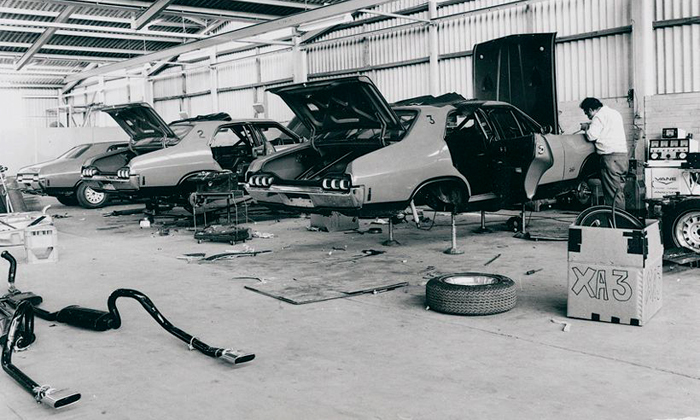
The three XA GT-HO Phase IV racing
prototypes being modified at the Ford Special Vehicle (FSV) workshop.
It should be noted when development was cancelled the three cars were
all in various stages of conversion
with XA-1 being the only completely finished and upgraded of the three
Phase IV racing prototypes. |
| |
|
|
| BODY STYLE |
Sedan |
| STANDARD FITTINGS |
|
| |
Engine: |
High Performance 340hp 351ci (5.8L) V8 / 4V / HC-HO |
| |
Transmission: |
Top Loader (Wide Ratio) Manual 4-spd Floor Shift |
| STANDARD PHASE IV FEATURES |
|
- Ford
'QC' Cleveland 351ci V8 engine featuring: 4V heads with
cylinder head machining for better volume and flow; super duty
conrod bolts; solid cam - twin point distributor; reworked 2.25 inch
exhaust headers, larger reworked baffled and winged oil sump;
1.5 litre oil capacity increase; larger radiator and redesigned fan
blades; reworked air cleaner housing & filter. |
| |
- Holley 780cfm 4V Carburettor |
| |
- 3.0:1 Detroit Locker 9 inch
Differential |
| |
- Panhard Rod on the
rear axle to counter 'torque steer' of the Detroit Diff. |
| |
- Lowered Suspension
with Double-Acting Shock Absorbers and revised
Rear Leaf Springs |
| |
- Widened Front and Rear Guards
for the fitting of various race tyres |
| |
- 15 x 7 inch Alloy Globe Wheels
with ER60 x 15 Olympic Reflex Tyres |
| |
- Brake Vacuum Tank and
Special Brake Linings (PH3) |
| |
- Additional Spot Welding
and Seam Welding during manufacture |
| |
- Roll Cage and
Graviner Fire Protection System (Race car builds) |
| |
- 8k Dashboard Tachometer |
| |
- 36 gallon Baffled Fuel Tank
(up to 40 gallons when modified by FSV) |
| |
- Carpeted Boot Lining
(Production car builds) |
| |
- GT-HO Sports Console Badge
(Production car builds) |
| |
|
|
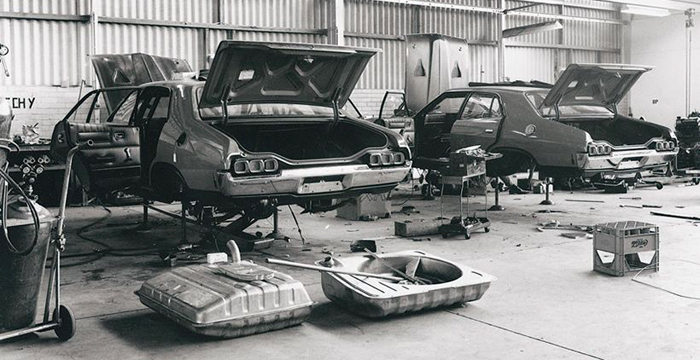
Another angle of Phase IV race cars 'XA-2'
and 'XA-3.' These cars had roll cages added and larger 36 gallon fuel
tanks
installed - the larger tank can be seen here in the bottom left of the
picture as it has no spare wheel well. |
| |
|
|
The
Supercar Scare
On 25 June, 1972 the Sydney Sun-Herald newspaper ran a front page story
by Evan Green stating that 160mph
Supercars would soon be available to the motoring public. This headline
has since became a piece of motor
racing history as it more or less took the blame for the widespread cancelling of car
manufacturers high
performance race
car developments using road going cars. The fact is the article was
essentially the "Straw
that broke the camel's back" so to speak in that there was already deep
public concerns around supercar
public sales going back to 1967. These concerns had slowly accumulated
in the public mind and government
fuelled by the steadily rising road fatality figures that by 1972 were
reaching the 3,500+ mark annually. While
these figures are not all squarely the result of overly powerful 'race
grade cars' in the hands of an inexperienced
public, they didn't help the situation either.
There are 'Supercar' accounts in multiple Australian newspapers of
public complaints and government minister
concerns - specific articles appeared in the Sydney Morning Herald in
March, 1967 and the AGE newspaper in
April, 1967. Further accounts were published in July, 1969 by mainstream
papers about 'Supercar' speeds, by
now
government ministers were threatening car manufacturers of fleet car
contract cancellations and the like. |
| |
|
|
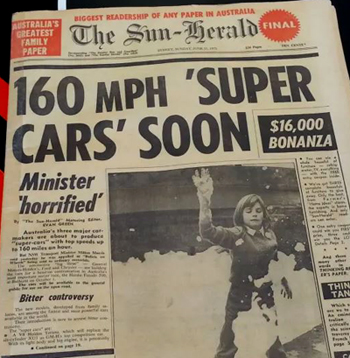
The infamous front page headline across the
cover of The
Sun-Herald on Sunday 25 June, 1972. |
| |
|
|
Five days before the infamous Evan Green
article would be published - on 20 June, 1972 - the Confederation of
Australian Motor Sport (CAMS), under enormous pressure, announced
(quietly) of the deletion of the Series-
Production race category essentially ending the Ford XA Falcon GT-HO
Phase IV program. It also finished the
Holden XU-1 Torana V8 and the new Chrysler Charger V8 race development
cars. Ford carried on the 1972 race
season in the XY Falcon GT-HO Phase III which at the time was the
"fastest four-door family car" in the world.
In 1973 CAMS created the Group C Touring Car rules, which would stay in
place until 1984, and Ford would race
the new XA Falcon GT coupes for the ATCC season including the now
rebranded Bathurst 1000 race.
As for the XA Falcon GT-HO Phase IV, the three race prototypes under
development were issued a stop work
notice by Ford on 30 June, 1972. The three cars were at various stages
of completion with only car XA-1 totally
finished and race tack tested. One production line XA Phase IV was
completed and it was ushered away to a
Ford dealer with the announcement by Ford to their dealer network that
the Phase IV never existed. |
| |
|
|
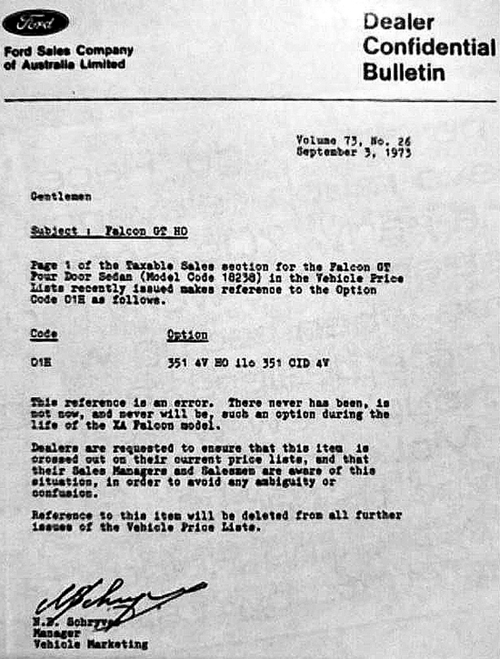
The bulletin issued to Ford dealers stating
that the Phase IV never existed. |
| |
|
|
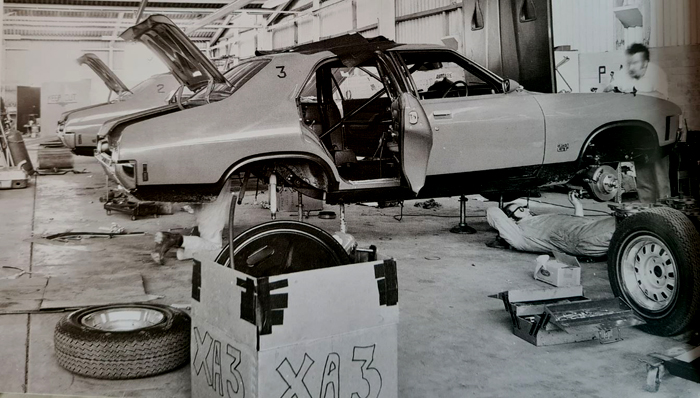
Phase IV racing prototype XA-3 being
modified by FSV mechanics who have already installed
a roll cage and removed some of the standard GT fittings like the
12-slots wheels. |
| aaaaa |
aaaaaaaaaaaaaaaaaaaaaaaaaaaaaaaaaaa |
aaaaaaaaaaaaaaaaaaaaaaaaaaaaaaaaaaaaaaaaaaaaaaaaaaaaaaaaaaaaaaaaaaa |
| THE XA GT-HO PHASE IV LINE
UP |
| |
|
|
|
|
|
|
JG33MC 76429 K |
|
| |
Type: |
1972 Ford XA Falcon GT Sedan |
|
| |
Model No.: |
18238 |
|
| |
Body Type: |
54H |
|
| |
VIN Number: |
JG33MC 76429 K |
|
| |
Country Built: |
J |
Australia |
|
| |
Plant: |
G |
Broadmeadows, Melbourne |
|
| |
Model Code: |
33 |
Falcon GT Sedan |
|
| |
Year Built: |
M |
1972 |
|
| |
Month Built: |
C |
May |
|
| |
Engine: |
T |
HP 300hp 351ci (5.8L) V8 / 4V / HC
(Pre 'QC' engine install) |
|
| |
Transmission: |
L |
Manual 4-spd Floor
Shift |
|
| |
Trim: |
B2 |
Black Vinyl & Cloth |
|
| |
Paint: |
Y117 |
Brambles Red (Coded: EY117 on
plate) |
|
| |
Standard GT RPOs: |
03 |
Seatbelts (Mandatory). |
|
| |
|
05 |
Power Disc Brakes (Front). |
|
| |
|
13 |
Heavy Duty Battery. |
|
| |
|
19 |
Reclining Bucket Seats. |
|
|
|
28 |
Super Duty Shock Absorbers. |
|
| |
|
30 |
Electric Clock. |
|
| |
|
32 |
Sports Console. |
|
| |
|
39 |
Carpets. |
|
| |
|
45 |
Limited Slip Differential. |
|
| |
|
56 |
Driving Lights. |
|
| |
|
62 |
Styled Exterior R/V Mirror RHS Remote Control. |
|
| |
|
67 |
Dual Exhaust System. |
|
| |
|
68 |
Sports Handling Suspension. |
|
| |
Optioned RPOs: |
11 |
Laminated Windscreen Tinted Band. |
|
| |
|
87 |
Tinted Side and Rear Windows. |
|
| |
SIDO No.: |
809891 |
Ford Special Vehicles (FSV) |
|
| |
|
|
|
|
| |
Notes: |
|
| |
Ordered 24 April, 1972. Delivered to FSV
10May, 1972.
No Tutone Black Hood (RPO 55) optioned.
Designated as the XA-1
Phase IV
conversion
prototype.
Fitted with roll cage and other racing modifications.
Earmarked to be Allan Moffat's race car.
Sold into private ownership. |
|
| |
Where is it now? |
|
|
The Bowden
Collection Museum, Warana, QLD. Fully restored for display. |
|
| |
|
|
|
|
JG33MC 78488 K |
|
| |
Type: |
1972 Ford XA Falcon GT Sedan |
|
| |
Model No.: |
18238 |
|
| |
Body Type: |
54H |
|
| |
VIN Number: |
JG33MC 78488 K |
|
| |
Country Built: |
J |
Australia |
|
| |
Plant: |
G |
Broadmeadows, Melbourne |
|
| |
Model Code: |
33 |
Falcon GT Sedan |
|
| |
Year Built: |
M |
1972 |
|
| |
Month Built: |
C |
May |
|
| |
Engine: |
T |
HP 300hp 351ci (5.8L) V8 / 4V / HC
(Pre 'QC' engine install) |
|
| |
Transmission: |
L |
Manual 4-spd Floor
Shift |
|
| |
Trim: |
B2 |
Black Vinyl & Cloth |
|
| |
Paint: |
Y117 |
Brambles Red (Coded: EY117 on
plate) |
|
| |
Standard GT RPOs: |
03 |
Seatbelts (Mandatory). |
|
| |
|
05 |
Power Disc Brakes (Front). |
|
| |
|
13 |
Heavy Duty Battery. |
|
| |
|
19 |
Reclining Bucket Seats. |
|
|
|
28 |
Super Duty Shock Absorbers. |
|
| |
|
30 |
Electric Clock. |
|
| |
|
32 |
Sports Console. |
|
| |
|
39 |
Carpets. |
|
| |
|
45 |
Limited Slip Differential. |
|
| |
|
56 |
Driving Lights. |
|
| |
|
62 |
Styled Exterior R/V Mirror RHS Remote Control. |
|
| |
|
67 |
Dual Exhaust System. |
|
| |
|
68 |
Sports Handling Suspension. |
|
| |
Optioned RPOs: |
11 |
Laminated Windscreen Tinted Band. |
|
| |
|
55 |
Tutone Black Hood (GT only). |
|
| |
|
87 |
Tinted Side and Rear Windows. |
|
| |
SIDO No.: |
816002 |
Ford Special Vehicles (FSV) |
|
| |
|
|
|
|
| |
Notes: |
|
| |
Ordered 1 May, 1972. Delivered to FSV 12
June, 1972.
Designated as the XA-2
Phase IV
conversion
prototype.
Fitted with roll cage and other racing modifications.
Earmarked to be Fred Gibson's race car.
Rally driven by Bruce Hodgson early 1970s. |
|
| |
Where is it now? |
|
| |
Destroyed in a
collision with a Commodore, wreck thought to still exist. |
|
| |
|
|
|
|
JG33MC 78489 K |
|
| |
Type: |
1972 Ford XA Falcon GT Sedan |
|
| |
Model No.: |
18238 |
|
| |
Body Type: |
54H |
|
| |
VIN Number: |
JG33MC 78489 K |
|
| |
Country Built: |
J |
Australia |
|
| |
Plant: |
G |
Broadmeadows, Melbourne |
|
| |
Model Code: |
33 |
Falcon GT Sedan |
|
| |
Year Built: |
M |
1972 |
|
| |
Month Built: |
C |
May |
|
| |
Engine: |
T |
HP 300hp 351ci (5.8L) V8 / 4V / HC
(Pre 'QC' engine install) |
|
| |
Transmission: |
L |
Manual 4-spd Floor
Shift |
|
| |
Trim: |
B2 |
Black Vinyl & Cloth |
|
| |
Paint: |
Y117 |
Brambles Red (Coded: EY117 on
plate) |
|
| |
Standard GT RPOs: |
03 |
Seatbelts (Mandatory). |
|
| |
|
05 |
Power Disc Brakes (Front). |
|
| |
|
13 |
Heavy Duty Battery. |
|
| |
|
19 |
Reclining Bucket Seats. |
|
|
|
28 |
Super Duty Shock Absorbers. |
|
| |
|
30 |
Electric Clock. |
|
| |
|
32 |
Sports Console. |
|
| |
|
39 |
Carpets. |
|
| |
|
45 |
Limited Slip Differential. |
|
| |
|
56 |
Driving Lights. |
|
| |
|
62 |
Styled Exterior R/V Mirror RHS Remote Control. |
|
| |
|
67 |
Dual Exhaust System. |
|
| |
|
68 |
Sports Handling Suspension. |
|
| |
Optioned RPOs: |
11 |
Laminated Windscreen Tinted Band. |
|
| |
|
55 |
Tutone Black Hood (GT only). |
|
| |
|
87 |
Tinted Side and Rear Windows. |
|
| |
SIDO No.: |
816003 |
Ford Special Vehicles (FSV) |
|
| |
|
|
|
|
| |
Notes: |
|
| |
Ordered 1 May, 1972. Delivered to FSV 12
June, 1972.
Designated as the XA-3
Phase IV
conversion
prototype.
Spare Phase IV conversion in case one of the other two were written off.
Fitted with roll cage and other racing modifications, least modified of
the Phase IVs.
Sent to Sydney Ford Dealer Max McLeod and sold as a road car. |
|
| |
Where is it now? |
|
|
Private owner
Sydney, NSW. Original and unrestored condition. |
|
| |
|
|
|
|
JG33MC 83054 K |
|
| |
Type: |
1972 Ford XA Falcon GT-HO Phase
IV Sedan |
|
| |
Model No.: |
18238 |
|
| |
Body Type: |
54H |
|
| |
VIN Number: |
JG33MC 83054 K |
|
| |
Country Built: |
J |
Australia |
|
| |
Plant: |
G |
Broadmeadows, Melbourne |
|
| |
Model Code: |
33 |
Falcon GT Sedan |
|
| |
Year Built: |
M |
1972 |
|
| |
Month Built: |
C |
May |
|
| |
Engine: |
H |
HP 340hp 351ci (5.8L) V8 / 4V Holley 780cfm / HC-HO |
|
| |
Transmission: |
L |
Manual 4-spd Floor
Shift |
|
| |
Trim: |
W |
White Vinyl |
|
| |
Paint: |
J |
Calypso Green Metallic |
|
| |
Standard GT RPOs: |
03 |
Seatbelts (Mandatory). |
|
| |
|
05 |
Power Disc Brakes (Front). |
|
| |
|
13 |
Heavy Duty Battery. |
|
| |
|
19 |
Reclining Bucket Seats. |
|
|
|
28 |
Super Duty Shock Absorbers. |
|
| |
|
30 |
Electric Clock. |
|
| |
|
32 |
Sports Console. |
|
| |
|
39 |
Carpets. |
|
| |
|
45 |
Limited Slip Differential. |
|
| |
|
56 |
Driving Lights. |
|
| |
|
62 |
Styled Exterior R/V Mirror RHS Remote Control. |
|
| |
|
67 |
Dual Exhaust System. |
|
| |
|
68 |
Sports Handling Suspension. |
|
| |
Optioned RPOs: |
10 |
Sun Roof. |
|
| |
|
11 |
Laminated Windscreen Tinted Band. |
|
| |
|
46 |
Power Windows. |
|
| |
|
52 |
Sports (Globe) Road Wheels - not factory listed. |
|
| |
|
55 |
Tutone Black Hood (GT only) - not factory
listed. |
|
| |
|
72 |
Radio / Stereo Tape Player (8-Track). |
|
| |
|
82 |
Front Spoiler (GT only) - not factory listed. |
|
| |
SIDO No.: |
648771 |
Jack Brabham Ford, Bankstown, NSW. |
|
| |
|
|
|
|
| |
Notes: |
|
| |
The only production Phase IV built -
ordered 15 May, 1972, build started 3 June, 1972.
Technically the only true Phase IV as it had the 'H' engine code on the
ID plate.
Arrived at Jack Brabham Ford on 17 January, 1973.
Sold to a customer on 26 March, 1973 with licence plates BJG126.
Acquired by present owner Paul Tobin in 1985. |
|
| |
Where is it now? |
|
|
Privately owned in
Australia by Paul Tobin (The Dentist). Fully restored. |
|
| aaaaaaaaaa |
aaaaaaaaaaaaaaaaaaa |
aaaaaaaaaaaa |
aaaaaaaaaaaaaaaaaaaaaaaaaaaaaaaaaaaaaaaaaaaaaaaaaaaaaaa |
aaaaaaaaaa |